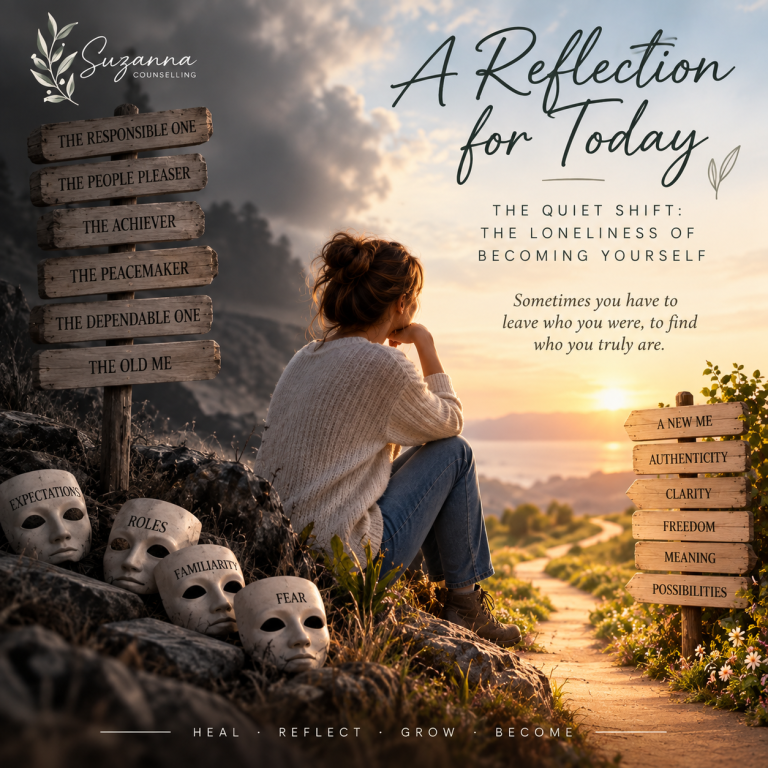

The Part of Change Nobody Talks About
What happens when the life you’ve been trying to create finally arrives – but you haven’t yet learned how to live inside it?
Most of us were raised inside structures that told us what to do, when to do it, and how to measure whether we had done it well; school, timetables, grades and routines on repeat. There is nothing wrong with structure, but it means we spent years practising how to follow an established path, and very little time practising how to question one, leave one, or build an entirely new one.
So when it comes to personal change, we arrive underprepared. Not because we lack intelligence or motivation – but because nobody ever taught us how to change. Understanding what needs to change and actually changing it are two very different tasks.
You can know something completely- intellectually, clearly, without any doubt and still automatically do the opposite. That is not hypocrisy or weakness. It is simply what happens when an old pattern has had considerably more practice than the new one.
This is the point where many people turn against themselves. I know what I need to do. I understand where it comes from. Why can’t I just do it differently? And then the frustration becomes another layer of suffering on top of the original one.
Insight tells us what needs to change, but it does not build the capacity. Transformation asks us to practice becoming someone who can live that insight and that is a different task entirely – one that requires considerably more understanding and practice.
Not the kind of practice we associate with skills or performance, but the quiet, unglamorous repetition of a new response, in the moments when every part of you wants to return to the old one. If you’ve always over-explained, you practise saying less. If you’ve always rescued, you practise allowing someone else to carry their own weight. If you’ve always avoided conflict, you practise staying present inside it. If you’ve always sought certainty before acting, you practise moving forward with some uncertainty still in hand. If you’ve always prioritised everyone else, you practise noticing your own needs first.
At first, none of this will feel like you and that matters because it isn’t familiar. But unfamiliar does not mean wrong and it certainly doesn’t mean it isn’t healthier. We develop psychological flexibility the same way we develop physical strength; through repeated use, in the presence of resistance and over time.
What makes this harder than most people expect is that we don’t only develop habitual behaviours, we develop habitual emotional states.
Someone can become deeply practised at anticipating problems, scanning for rejection, feeling responsible for others’ wellbeing, expecting things not to work, feeling guilty when they prioritise themselves, or feeling powerless the moment something becomes difficult. These are not simply reactions, they become our emotional landscape from which life is interpreted and it’s our predictive system that drives our choices.
Consequently when we say I want my life to look different, we are asking for a different life while still operating from the same internal world. That is why insight alone can feel so frustrating. The mind has understood something new, but the emotional system hasn’t yet learned how to inhabit it. This is also why change can feel deeply uncomfortable even when it is genuinely going well.
Someone accustomed to chaos may experience peace and interpret it as boredom. Someone used to emotionally unavailable relationships may finally meet someone present and available and find that availability itself feels unsettling. Someone who has spent years over-functioning may finally be cared for, and feel more vulnerable than relieved. We don’t return to old patterns only because we prefer the life that came with them. We return because the emotional experience of that pattern has become familiar. This familiarity, to the nervous system, can feel safer than wellbeing and not because we want to suffer, but because the old pattern is known and we know how to inhabit it.
Change isn’t only about breaking an old habit. It is about developing the capacity to tolerate the unfamiliarity of a new one.
So perhaps the real question isn’t why do I keep doing this when I understand what I need to do differently? Perhaps the question is: have I ever actually learned how to feel safe being different? These are two very different questions with the second one opening a far more honest door.
Authorship isn’t simply imagining a different story, it is beginning to write differently. It means practising the thoughts, emotions, choices and behaviours of the person who could actually live there and choosing to staying there, even when the new life feels strange. This means practising receiving without withdrawing, practising peace without creating chaos, practising intimacy without abandoning yourself and practising disappointment without returning to hopelessness. That is where the future self becomes present behaviour. Understanding is cognitive but change is experiential and transformation requires something rarer than either – the courage to keep practising a version of yourself that initially feels unfamiliar, until one day, quietly, it begins to feel like home.