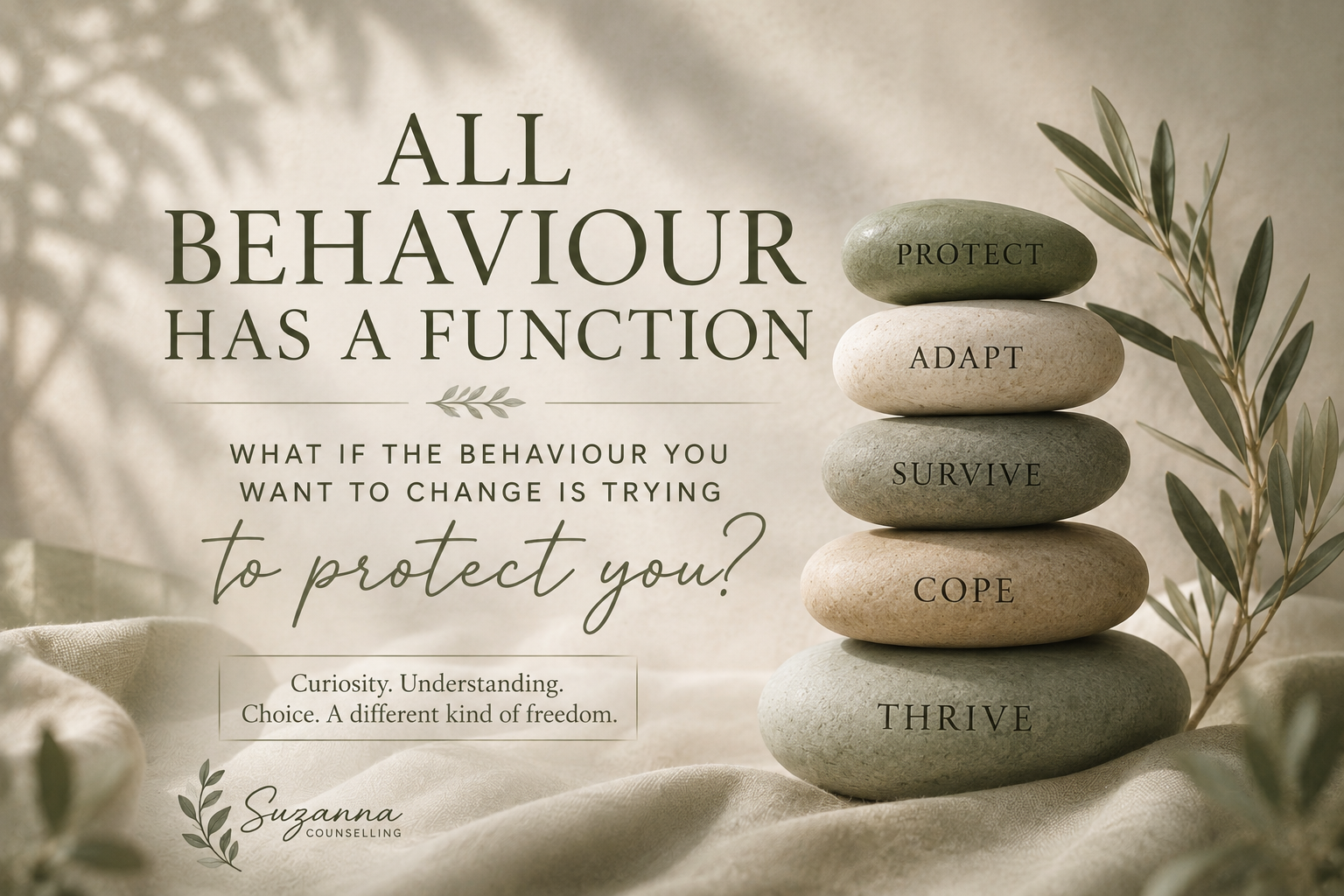
All Behaviour Has A Function
What if the behaviour you want to change is trying to protect you?
There are times in our lives when we begin to feel stuck because the identity we have been living from no longer fits the reality we find ourselves in. This can become particularly visible after a life-changing event such as divorce. There is the identity we once knew, our spouse, partner, family unit – alongside the reality of what is happening now. Then there is the uncertainty of what comes next.
The moment we realize that we are responsible for building a new life can be terrifying. It can mean accepting that the life we knew is changing. Relinquishing the hope attached to the identity that once felt safe. Grieving what has been lost. Perhaps carrying the painful question: “What could I have done differently?”
The hardest part may be knowing that life has changed while not knowing whether we have the capacity, confidence or resources to move forward into the unknown. Sometimes what looks like being stuck is actually a person trying to find psychological safety in the only place that still feels familiar.
From the outside, being consumed by the unfairness of a situation can look like victimhood. But from the inside, it may feel very different. It may be a storm of grief, anger, fear, helplessness and uncertainty. Sometimes focusing on what happened – who was wrong, what should have been different, what someone else should have done – provides a sense of certainty in a life that suddenly feels uncertain.
It gives us something to organize around and perhaps, for a while, that protection is necessary. In divorce, for example, the marriage may end while the psychological identity of the family remains intact. The children may become the central purpose around which life continues to be organized whilst the development of a new identity is postponed.
The person remains psychologically connected to what has been lost because imagining what comes next feels more frightening than remaining in what is known. They become organized around loss rather than possibility. This doesn’t mean the loss wasn’t real. It means that the way we respond to the loss may also be serving a function, and this is where curiosity becomes important.
One way of understanding some patterns of helplessness or hopelessness is through what some coping-mode frameworks describe as pseudo-vulnerability – a coping mode that can emerge when someone feels overwhelmed, helpless or unable to face what comes next. From this perspective, helplessness can sometimes serve as a protective function. It may temporarily protect us from the possibility of failure, from responsibility, from uncertainty or, from having to confront the terrifying question: “What if I don’t know how to build a new life?”
It may also bring something we deeply need – validation, significance or the reassurance of being seen. This behaviour may not be consciously chosen but rather it may simply be the strategy that has become most familiar. It might look like someone who keeps turning down opportunities that would raise their profile at work, not for lack of ability, but because staying unseen has kept them safe from judgment for years.
This is where I think we need to become curious rather than judgmental. Instead of asking: “Why can’t I just move forward?” Perhaps we can ask: “What is staying here doing for me?” What am I protecting myself from? What would I have to face if I stopped doing this? What does this pattern give me? What does it cost me? Perhaps the most important question, which is does this adaptation still serve the life I am trying to build?
We are born with fundamental needs for safety, connection, belonging and significance. As we move through life, we develop ways of responding to our environment and relationships. We adapt, we learn what creates connection, we learn what protects us, we learn what helps us feel safe and this is an extraordinary human capacity. Adaptation is not weakness but is often an intelligent response to the circumstances we have experienced.
The difficulty comes when a strategy that once helped us survive becomes so familiar that it starts to feel like part of our identity. We don’t simply use the coping mechanism anymore, we begin to organize our lives around it, and what once protected us can eventually limit us.
Healing isn’t becoming someone who doesn’t need coping mechanisms, and neither is healing the absence of coping mechanisms, but rather, it is discovering that we may no longer need the same strategies to feel emotionally safe. It is about recognizing the pattern without shaming ourselves for finding ways to cope. Healing starts when we become curious enough to understand why we needed to be this way – the goal isn’t to destroy the parts of ourselves that adapted but rather to understand our coping ways as they helped us survive.
Who we become is built over time. It is shaped by our families, our relationships, our culture, our experiences, our wounds, our strengths and the choices we make along the way. Some parts of us were shaped by survival, some were shaped by love, some by belonging, some by adversity and some parts by the person we consciously decided to become.
So, perhaps reclaiming ourselves isn’t about stripping away every layer until we discover some untouched version of who we were always meant to be. It is more nuanced than that as it is a process of uncovering and discovering. It is about distinguishing between what was necessary then versus what still serves me now. What I have learned along the way and what I consciously want to carry forward. We don’t have to reject everything we became in order to become something different as some of the very qualities we developed through difficult experiences may become strengths we carry into the next chapter.
Curiosity creates choice and this is where change begins. It does not have to be a dramatic decision, sometimes it begins with noticing – there I am doing that thing again. Instead of blaming or judging ourselves we become curious about what is going on. Curiosity creates space and space creates choice.
When we understand the function of a coping strategy, we can begin to develop new ways of thinking, relating and responding. We can remain connected to ourselves while creating new experiences of safety. We can begin to discover that the thing we once needed for protection, is no longer the only way we know how to respond.
Becoming the author of the next chapter of our lives doesn’t begin with reinventing ourselves. It begins by becoming curious about the layers that brought us here – the parts shaped by survival, the parts shaped by experience, and the parts we are choosing to carry forward – while honoring the strengths we developed along the way.
When we understand the function of our behaviour, we no longer have to be defined by it – and that is where a different kind of freedom begins.