
You Were Never Meant to Serve Time for Being Human
Perhaps the reason you cannot forgive yourself is not because you haven’t tried hard enough – but because you are trying to forgive too many things at once. Many people speak about self-forgiveness as though it were a single act; a decision to make, a switch to flip, a sentence to repeat. But self-forgiveness is rarely about one thing. It is often not one wound, but many wounds living inside one story.
When we look back on something we regret, we may believe we are trying to forgive a single event. Yet hidden inside that regret are often many layers: remorse for harm caused, grief for what followed, shame for acting outside our values, confusion about how it happened, and fear that what happened says something permanent about who we are.
Self-forgiveness does not require denial. It does not ask us to minimise what happened or rewrite history into something easier to bear. In fact, it asks for something harder – to tell the truth without becoming only the truth of the mistake.
There is a difference between I did something I regret and I am only someone who causes regret. The first is accountability. The second is identity collapse.
Many painful decisions are not made in a vacuum. They happen in seasons of loneliness, exhaustion, disconnection, or the longing to feel seen, wanted, or alive. This context does not erase responsibility – but context matters, because sometimes we punish ourselves not only for what we did, but for having been vulnerable enough to do it.
Vulnerability is not proof of foolishness but rather it is proof of being human and understanding the circumstances around a decision is not the same as excusing it, it is simply allowing ourselves to see the whole picture.
Perhaps one of the most painful parts of regret is what it does to how one see oneself. We may have believed we were loyal, strong, wise – the kind of person who would never do that and when our behaviour contradicts the person we believed ourselves to be, the resulting shame can be profound.
The problem isn’t that the identity was false – perhaps it was simply incomplete. We are often more complex than the version of ourselves we hoped would always remain true. There are parts of us that are courageous and parts that are afraid. Parts that are wise and parts that become lost.
Self-forgiveness may therefore require us to grieve the idealised version of ourselves and meet the real self with honesty – not as a lesser self, but rather as a fuller one. Because becoming whole does not mean becoming someone who has never made mistakes. It means becoming someone who can hold the truth of their humanity without abandoning themselves.
Some regrets continue because the consequences are still visible – a family changed shape, a relationship was altered, a decision changed the direction of life forever. When consequences remain present, the past can feel as though it is still happening. Yet it can be harmful to hold ourselves as the sole author of every ongoing consequence. Our lives are shaped by many forces – other people’s choices, time, circumstance, family systems and loss. One decision may have mattered deeply, but it is rarely the only factor in the whole story. We can take responsibility for our part without taking responsibility for everything that came after.
Some people unconsciously believe that continued suffering is evidence of conscience – if I still hurt, then I care and if I continue to punish myself, then I am moral. But self-punishment is not the same as integrity. Sometimes it becomes a way of staying loyal to pain, as though letting ourselves heal would mean that what happened no longer mattered.
Self-forgiveness does not say it didn’t matter. It says: it mattered. I see it clearly. I regret parts of it deeply. I understand more now than I did then and I choose to live differently.
Perhaps self-forgiveness is not a single moment of release – perhaps it is a slower process where we forgive one layer, then another. The behaviour, the vulnerability, the shame, the broken self-image. Until eventually we stop asking how could I have done that? and begin asking how do I carry this chapter with truth, compassion, and wisdom now?
The goal is not to erase the chapter or to pretend it didn’t happen or to become the person we were before. It is to allow the experience to become part of a fuller understanding of who we are.
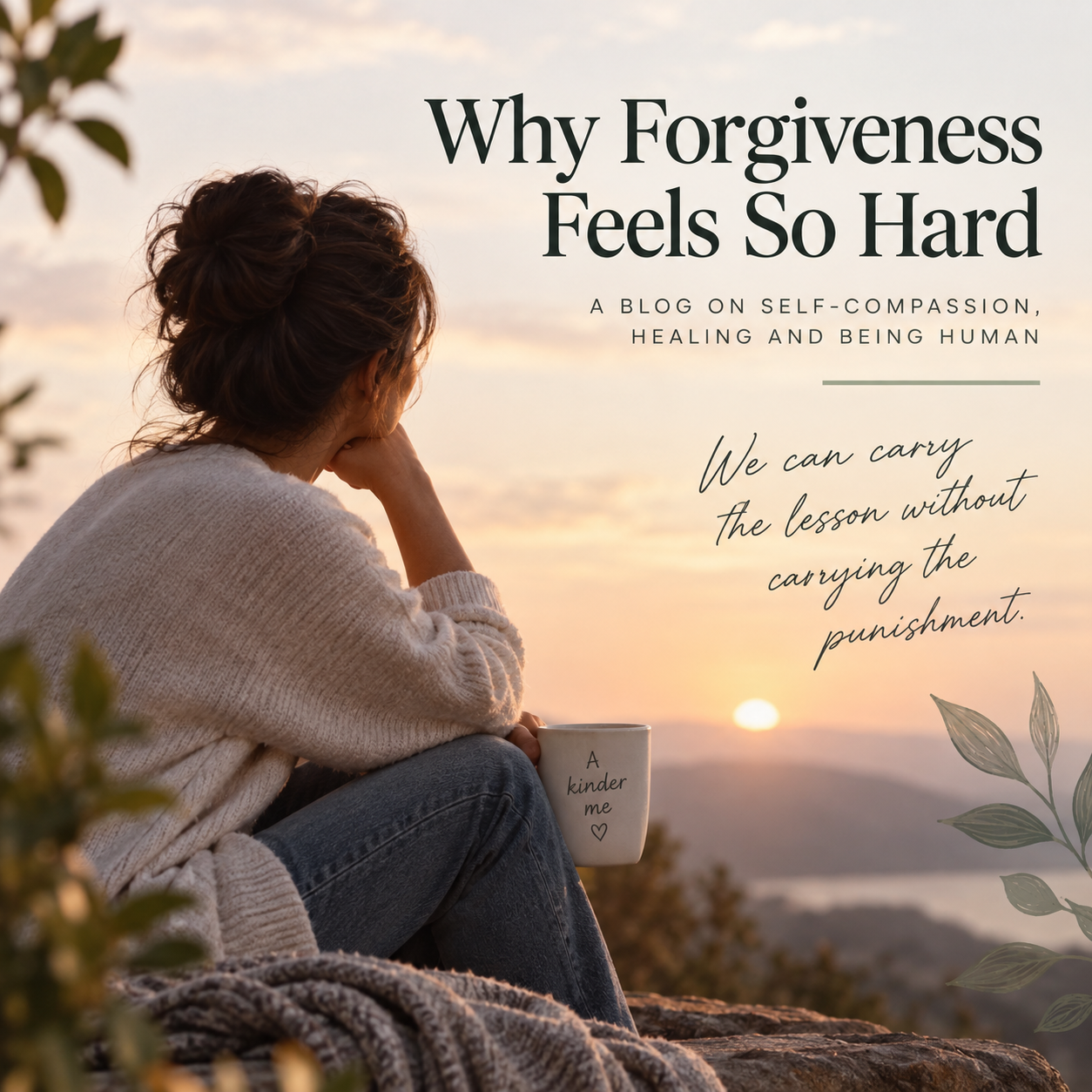
We can carry the lesson without carrying the punishment. We can take responsibility without making ourselves the villain of our own story.
Perhaps self-forgiveness is not to forget the past – but to stop turning it into a life sentence.