The Invisible Contract We Never Knew We Signed
I used to think obligation meant being a good person. It took me a long time to realise that many of my ‘shoulds’ weren’t choices but rather they were survival strategies. Perhaps you know this feeling, where along the way you learned that disappointing someone felt unsafe. So, you learned how to anticipate, accommodate, explain and over-give. This happens not because we are naturally generous, but because our nervous system believes connection depends on it.
Obligation is often defined as a duty based conscience, values or doing what is right. Yet emotionally, obligation speaks a different language. Obligation whispers, “You should.”, Guilt whispers, “How could you not?”; Shame quietly asks, “What kind of person would you be if you didn’t?”
Together they create an invisible prison – not because we are weak, but because these messages were often installed long before we had the maturity to question them.
An emotionally volatile or unpredictable environment teaches a child that non-compliance is dangerous. A child quickly learns to accommodate and overcompensate, not because they want to, but because giving more than expected becomes insurance against conflict, and so love begins to feel conditional. A child learns to anticipate before being asked, to give before receiving, to rescue before anyone feels disappointed, and to say “yes” before they have even discovered what they themselves want.
This is not weakness, it is brilliance. It is a nervous system intelligently adapting to survive the world it was born into and this prevention strategy works. It reduces punishment, it lowers conflict, it helps to preserve connection. As children, we do not consciously choose these strategies but rather our nervous system chooses them for us, and so obligation quietly becomes the price of belonging.
Over time we become exceptionally skilled at reading the room, anticipating needs, fixing problems and staying one step ahead of disappointment. Not because we are naturally responsible but because connection became linked to compliance.
Obligation in itself is not the problem, in healthy relationships, we all experience responsibility and commitment. The difficulty begins when obligation becomes the way we believe love works and when giving becomes the price of acceptance, when carrying more than our share becomes the cost of staying connected and when freedom feels like something that has to be earned.
A coping mechanism is never a character flaw, it is an intelligent adaptation to the environment in which it was needed. The difficulty is that what once protected us often continues long after the danger has passed. As adults we rarely stop to ask ourselves a simple question. Who wrote this contract?
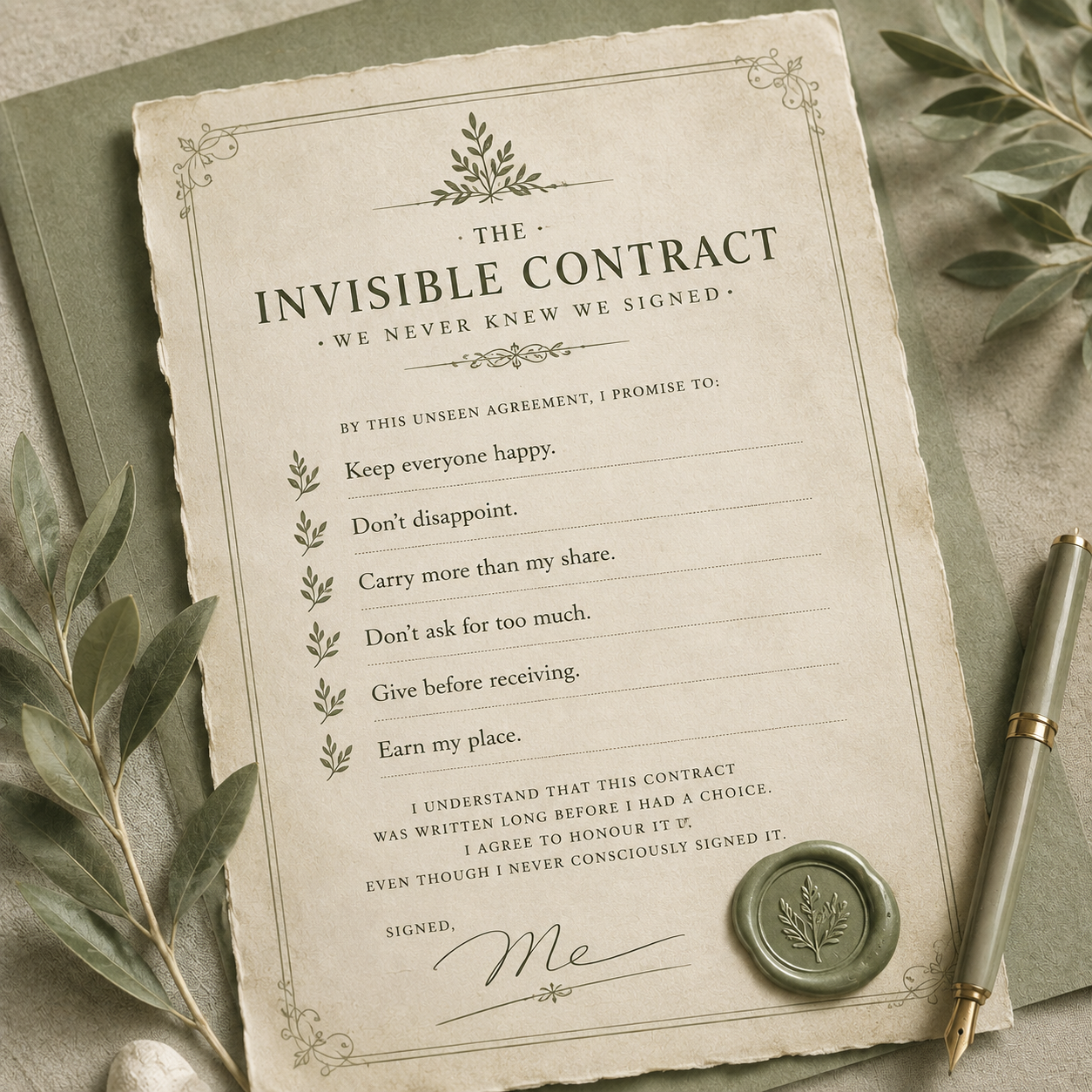
Somewhere in childhood an invisible contract was written. It quietly said: Keep everyone happy. Don’t disappoint. Carry more than your share. Don’t ask for too much. Give before receiving. Earn your place!. No child consciously signs this contract, our nervous system does, and years later we continue honouring rules we never knowingly agreed to. Obligation is not the opposite of love. For many of us…Obligation became what love looked like.
The first step isn’t to tear the contract up but rather it is to become curious about it. Reflecting on questions such as; what do I believe I owe others?, what happens inside of me when I say no?, whose disappointment am I afraid of?, what do I imagine will happen if I stop carrying what was never mine to carry?
When obligation has been part of how we maintain connection, choosing differently can initially feel uncomfortable and maybe even selfish. In these moments we may experience guilt and question ourselves. It can lead us to wonder whether we have become uncaring, hardened or even difficult. But, perhaps that discomfort is not evidence that we are doing something wrong, but rather it is simply the unfamiliar experience of choosing ourselves.
The work is not to stop caring about others – it is to stop abandoning ourselves in order to care for others; and this becomes the moment when the invisible contract begins to lose its authority.
Healing is choosing truth over obligation, compassion over self-criticism, loyalty to ourselves over endless negotiation. It is remaining true without becoming hard, kind without abandoning ourselves and generous without disappearing. Healing doesn’t happen because guilt disappears, healing happens because guilt no longer becomes our compass.
Stop asking What should I do? and begin asking What is true for me? When this shift happens is the day obligation begins to lose its grip. Not because we stopped loving, but because we finally stopped confusing love with earning our place. And perhaps that is where freedom quietly begins. The moment truth and safety finally learn to live in the same place.